MATHEMATICS: TRADITIONAL METHODS
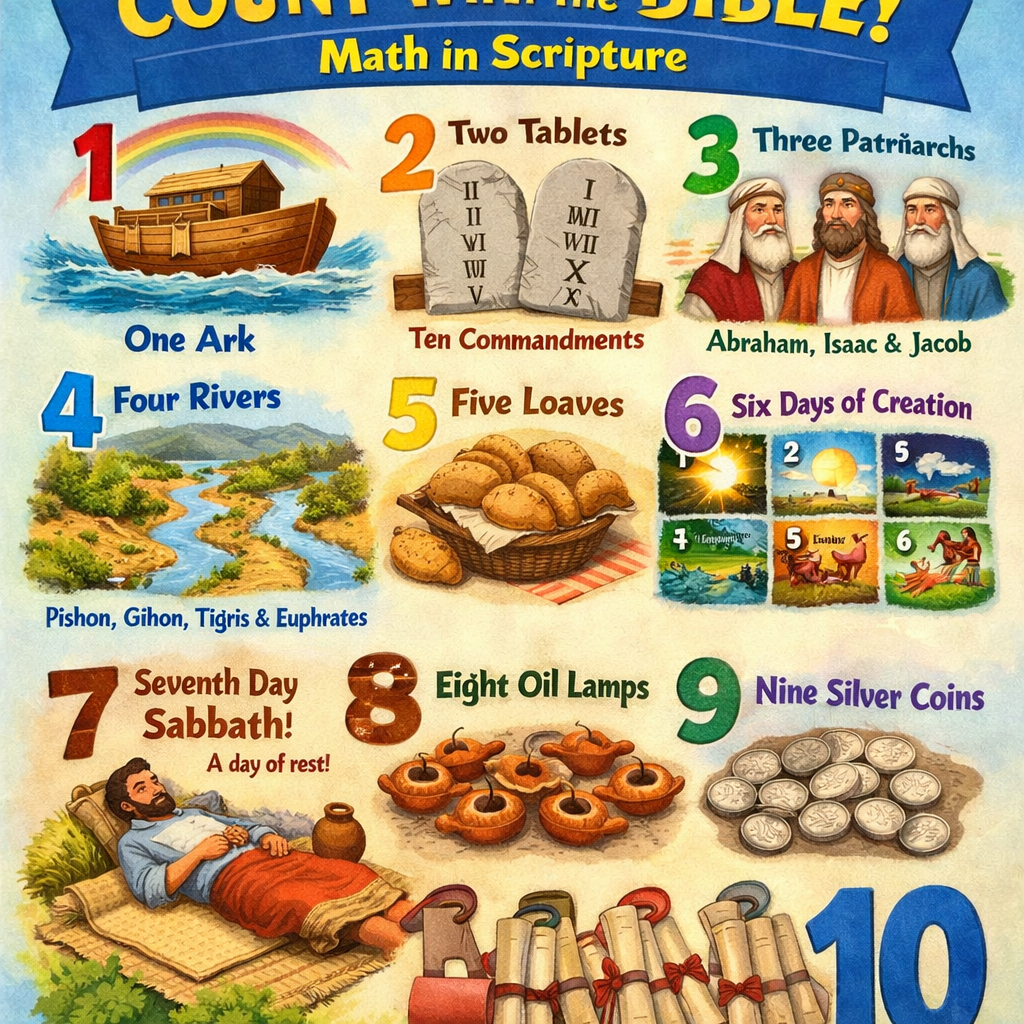
Learning to count with Yahuah!
Youth Edition (Ages 12-17) • Truth Carriers 6Rs
Proverbs 22:29
"Do you see a person skilled in their work? They will stand before kings."
Why Traditional Methods?
- Clear, efficient algorithms that work every time
- Mastery first — automatic facts free brain space for higher math
- Real-world practice (money, measurements, science, trades)
- Biblical stewardship: excellence, honesty, and diligence
How to Use (6Rs Method)
1. RECEIVE
Read the teaching and examples.
2. REFLECT
Work the practice problems.
3. RECALL
Close the book; write steps from memory.
4. RECITE
Teach a friend or sibling.
5. REVIEW
Use the spaced-review table.
6. RESPOND
Apply math in real-life tasks.
Lesson 1: Strong Foundations (Place Value & Facts)
Solid place value and automatic facts make every other topic faster and clearer.
Place Value: Each digit’s value depends on its position (ones, tens, hundreds, thousands).
| Number | Expanded Form | Say It |
|---|
| 4,506 | 4,000 + 500 + 6 | "Four thousand five hundred six" |
| 72,019 | 70,000 + 2,000 + 19 | "Seventy-two thousand nineteen" |
Quick Drills
1) 3,407 = ______ thousands + ______ tens + ______ ones
2) What digit is in the ten-thousands place of 56,912? ______
3) 8 hundreds + 7 tens + 5 ones = ______
Multiple Choice
1. In 29,681 the digit 9 means:
○ A) 9 ones ○ B) 9 tens ○ C) 9 thousands
2. 7,050 said correctly is:
○ A) Seven thousand fifty ○ B) Seven zero five zero ○ C) Seven hundred fifty
True / False
○ T ○ F — 40,012 has a 4 in the ten-thousands place.
○ T ○ F — Memorizing facts frees your brain for tougher problems.
Recall (Close your book)
Write the place values from ones to hundred-thousands and give one example.
Apply
Lesson 2: Standard Algorithms (Add, Subtract, Multiply, Divide)
Traditional algorithms are reliable, fast, and easy to check.
Steps to Add/Subtract Multi-Digit
- Line up place values.
- Start in ones; carry or borrow as needed.
- Check with inverse (add back or subtract back).
Long Multiplication (example 347 × 26)
- 347 × 6 (ones row)
- 347 × 2 (tens row) → write one zero first
- Add the two partial products
Long Division (example 864 ÷ 7)
- Divide → Multiply → Subtract → Bring down (repeat)
- Write remainders clearly or express as fraction
Practice
1) 4,785 + 2,968 = ______
2) 6,003 − 2,458 = ______
3) 243 × 18 = ______
4) 952 ÷ 7 = ______ remainder ______
Multiple Choice
1. When multiplying by a tens digit you should:
○ A) Ignore the zero ○ B) Add a zero placeholder ○ C) Start from left
2. The inverse to check subtraction is:
○ A) Multiply ○ B) Add ○ C) Divide
True / False
○ T ○ F — In long division you bring down one digit at a time.
○ T ○ F — Estimating first helps you catch place-value mistakes.
Recall
Write the four steps of long division without looking.
Apply
Lesson 3: Fractions, Decimals, Percents
These are three ways to write the same quantity. Converting quickly is key.
Basics: Fraction → divide top by bottom to get decimal; move decimal ×100 to get percent.
| Fraction | Decimal | Percent |
|---|
| 1/2 | 0.5 | 50% |
| 1/4 | 0.25 | 25% |
| 3/4 | 0.75 | 75% |
| 1/5 | 0.2 | 20% |
Operations
- Add/Subtract: Common denominator, add numerators, simplify.
- Multiply: Multiply tops, multiply bottoms, simplify.
- Divide: Keep-Change-Flip (invert the second fraction, then multiply).
Practice
1) 3/8 + 1/4 = ______
2) 2/3 × 3/5 = ______
3) 5/6 ÷ 2/3 = ______
4) 18% of 50 = ______
5) Convert 0.35 to fraction (simplest): ______
Multiple Choice
1. To divide fractions you should:
○ A) Common denominator first ○ B) Keep-Change-Flip ○ C) Cross-add
2. 30% as a decimal is:
○ A) 0.03 ○ B) 0.30 ○ C) 3.0
True / False
○ T ○ F — Simplifying at the end is okay, but checking mid-step can help.
○ T ○ F — Percent means “per hundred.”
Scripture Memory: Proverbs 11:1
"A false balance is abomination to Yahuah, but a just weight is His delight."
Recall
Write the three conversions (fraction ↔ decimal ↔ percent) and one example of each.
Apply
Lesson 4: Algebra Basics (Solve for x)
Solving equations is about isolating the variable with inverse operations.
Steps
- Simplify both sides (combine like terms).
- Undo addition/subtraction first.
- Undo multiplication/division second.
- Keep balance: what you do to one side, do to the other.
Examples
x + 7 = 19 → x = 12
3x − 5 = 16 → 3x = 21 → x = 7
4(x + 2) = 28 → x + 2 = 7 → x = 5
Practice
1) x + 9 = 21 → x = ______
2) 5x = 45 → x = ______
3) 2x + 6 = 22 → x = ______
4) (x − 3)/4 = 5 → x = ______
Multiple Choice
1. First step to solve 2x + 5 = 19:
○ A) Multiply by 2 ○ B) Subtract 5 ○ C) Add 5
2. Inverse of multiplying by 4 is:
○ A) Add 4 ○ B) Divide by 4 ○ C) Subtract 4
True / False
○ T ○ F — Distributing 3 over (x + 2) gives 3x + 6.
○ T ○ F — You can check by plugging your answer back in.
Recall
Write the “undo” order for two-step equations.
Apply
Lesson 5: Geometry & Pythagorean Theorem
Right triangles unlock distances and design.
Pythagorean Theorem: a² + b² = c² (c is the hypotenuse).
| Triangle | a | b | c |
|---|
| 3-4-5 | 3 | 4 | 5 |
| 5-12-13 | 5 | 12 | 13 |
Practice
1) Legs 6 and 8 → c = ______
2) Leg 9, hypotenuse 15 → other leg = ______
3) How long is a ladder reaching 12 ft up with base 5 ft out? ______
Multiple Choice
1. Pythagorean theorem works for:
○ A) All triangles ○ B) Right triangles only ○ C) Squares
2. The hypotenuse is the side:
○ A) Opposite the right angle ○ B) Shortest side ○ C) With a right angle
True / False
○ T ○ F — 7, 24, 25 is a Pythagorean triple.
○ T ○ F — To solve for a leg: subtract squares, then square root.
Recall
Write the formula and one real-life use (carpentry, measuring a diagonal, etc.).
Apply
Lesson 6: Patterns, Stewardship, and Faith
Math reveals order in creation and helps us steward resources with integrity.
Patterns: Fibonacci (0,1,1,2,3,5,8,13...) appears in flowers, shells, galaxies. Golden ratio ≈ 1.618 shows design.
Psalm 19:1
"The heavens declare the glory of Elohim; the skies proclaim the work of His hands."
Financial Stewardship Basics
- Track: Income − Giving − Saving − Spending = 0 (zero-based plan)
- Percentage sense: 10% giving, 10% saving, planned spending
- Honesty: accurate totals, no “fuzzy math” (Proverbs 11:1)
Practice
1) Next Fibonacci number after 13 is ______
2) If you earn $80, 10% giving + 10% saving = ______ each
3) Golden ratio rounded to two decimals = ______
Multiple Choice
1. Which is NOT a Fibonacci number?
○ A) 8 ○ B) 21 ○ C) 14
2. A “false balance” in Proverbs 11:1 warns against:
○ A) Checking math twice ○ B) Cheating weights/measurements ○ C) Using calculators
True / False
○ T ○ F — Math patterns in nature point to design.
○ T ○ F — Stewardship includes truthful numbers and planned giving.
Recall
List the first 7 Fibonacci numbers from memory.
Apply
SPACED REVIEW
Check when you review each lesson.
Answer Key (Quick Check)
Lesson 1
3,407 = 3 thousands, 0 tens, 7 ones; digit = 6 in ten-thousands of 56,912; 875. MC: 1-C, 2-A. TF: T, T.
Lesson 2
1) 7,753 2) 3,545 3) 4,374 4) 136 r 0 (if 952÷7 = 136) — MC: 1-B, 2-B. TF: T, T.
Lesson 3
1) 5/8 2) 2/5 3) 1 1/4 4) 9 5) 7/20. MC: 1-B, 2-B. TF: T, T.
Lesson 4
1) 12 2) 9 3) 8 4) 23. MC: 1-B, 2-B. TF: T, T.
Lesson 5
1) 10 2) 12 3) 13. MC: 1-B, 2-A. TF: T, T.
Lesson 6
Next Fibonacci: 21; 10% of $80 = $8; Golden ratio ≈ 1.62. MC: 1-C, 2-B. TF: T, T.
TRUTH CARRIERS EDUCATION SYSTEM
“Test all things; hold fast what is good.” — 1 Thessalonians 5:21