Heroes of the Faith Who Stood for Scripture
TRUTH CARRIERS EDUCATION SYSTEM
True History Series - Youth Tier (Ages 12-17)
This workbook explores the Protestant Reformation - a pivotal moment when brave men and women returned to Scripture as the ultimate authority for faith and practice. You will meet reformers who risked everything, including their lives, to ensure ordinary people could read the Bible in their own language.
What You Will Learn:
Audience: Youth ages 12-17
Study Time: 10 lessons, approximately 45-60 minutes each
Method: 6Rs Learning System (Receive, Reflect, Recall, Recite, Review, Respond)
| Date | Event |
|---|---|
| c. 1170 | Peter Waldo begins Waldensian movement |
| c. 1384 | John Wycliffe dies; first English Bible |
| 1415 | Jan Hus burned at the stake |
| 1517 | Luther posts 95 Theses (October 31) |
| 1521 | Diet of Worms - Luther's famous stand |
| 1525-26 | Tyndale's English New Testament printed |
| 1536 | William Tyndale martyred; Calvin's Institutes published |
| 1545-1563 | Council of Trent (Counter-Reformation) |
| 1559 | Index of Forbidden Books established |
| 1655 | Piedmont Massacre of Waldenses |
YOUTH Reform Wycliffe
Imagine living in a world where you could never read the Bible for yourself. For nearly a thousand years in Europe, this was reality. The Bible existed only in Latin - a language most people could not understand. The church held a monopoly on Scripture, and ordinary believers depended entirely on priests to tell them what the Bible said.
By the late Middle Ages (often called the "Dark Ages" for spiritual reasons), the church had drifted far from the simplicity of the New Testament. Consider these conditions:
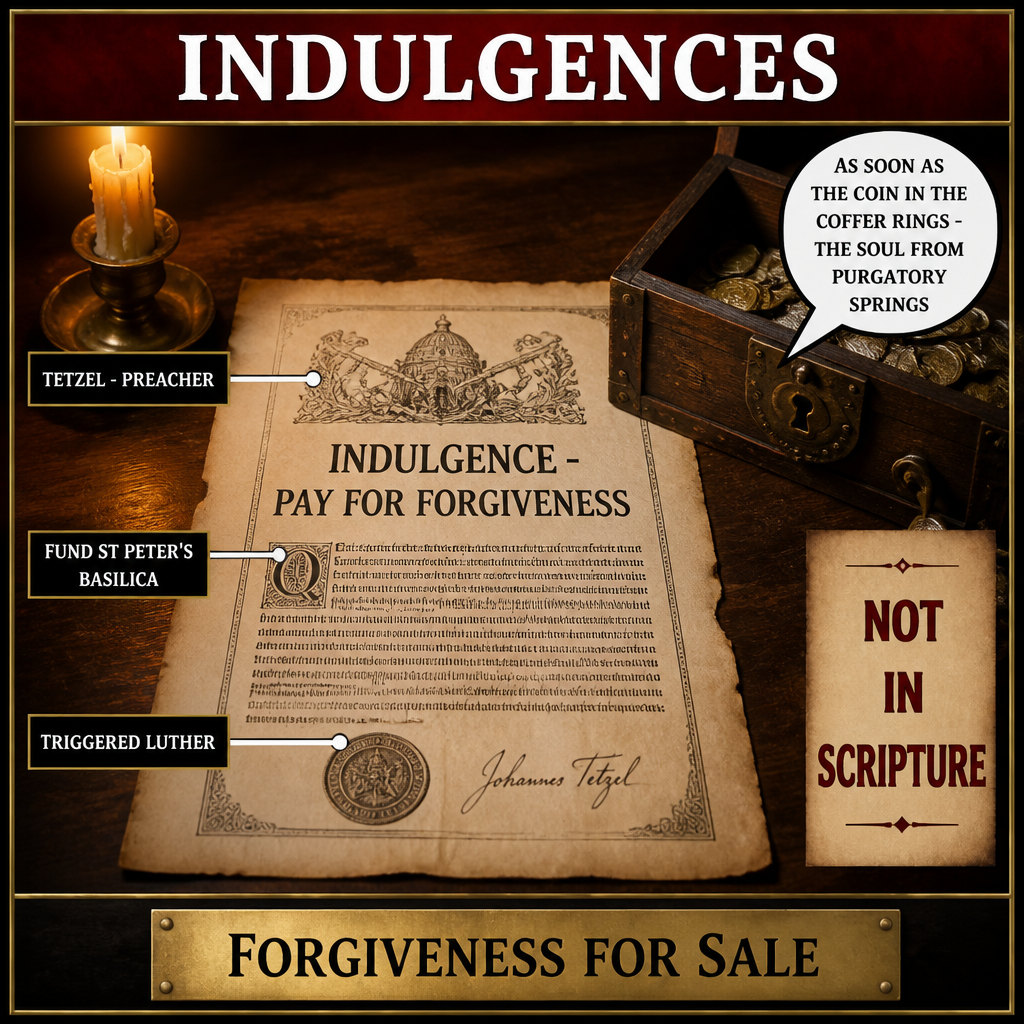
Indulgences were certificates sold by the church that promised to reduce punishment for sins - either for yourself or for deceased loved ones supposedly suffering in purgatory. Pope Leo X authorized Johann Tetzel to sell indulgences across Germany to raise money for rebuilding St. Peter's Basilica in Rome.
Without access to Scripture, people could not verify whether what they were told was actually in the Bible. They trusted their priests, who trusted their bishops, who trusted the Pope. If the leaders at the top were wrong, the entire system was built on error.
1. Why do you think the church kept the Bible in Latin instead of translating it into common languages?
2. How would your faith be different if you could never read the Bible yourself?
3. Read 2 Timothy 3:16-17. According to this verse, why is Scripture important for every believer?
2 Timothy 3:16-17 - "All scripture is given by inspiration of Yahuah, and is profitable for doctrine, for reproof, for correction, for instruction in righteousness: That the man of Elohim may be perfect, throughly furnished unto all good works."
Practice saying aloud:
Personal Application: You have something medieval believers did not have - direct access to Scripture in your own language. How will you use this privilege? Write your commitment below:
Prayer Focus: Thank Yahuah for the reformers who sacrificed so you could have the Bible in your language. Ask Him to help you treasure His Word.
YOUTH Reform Hus
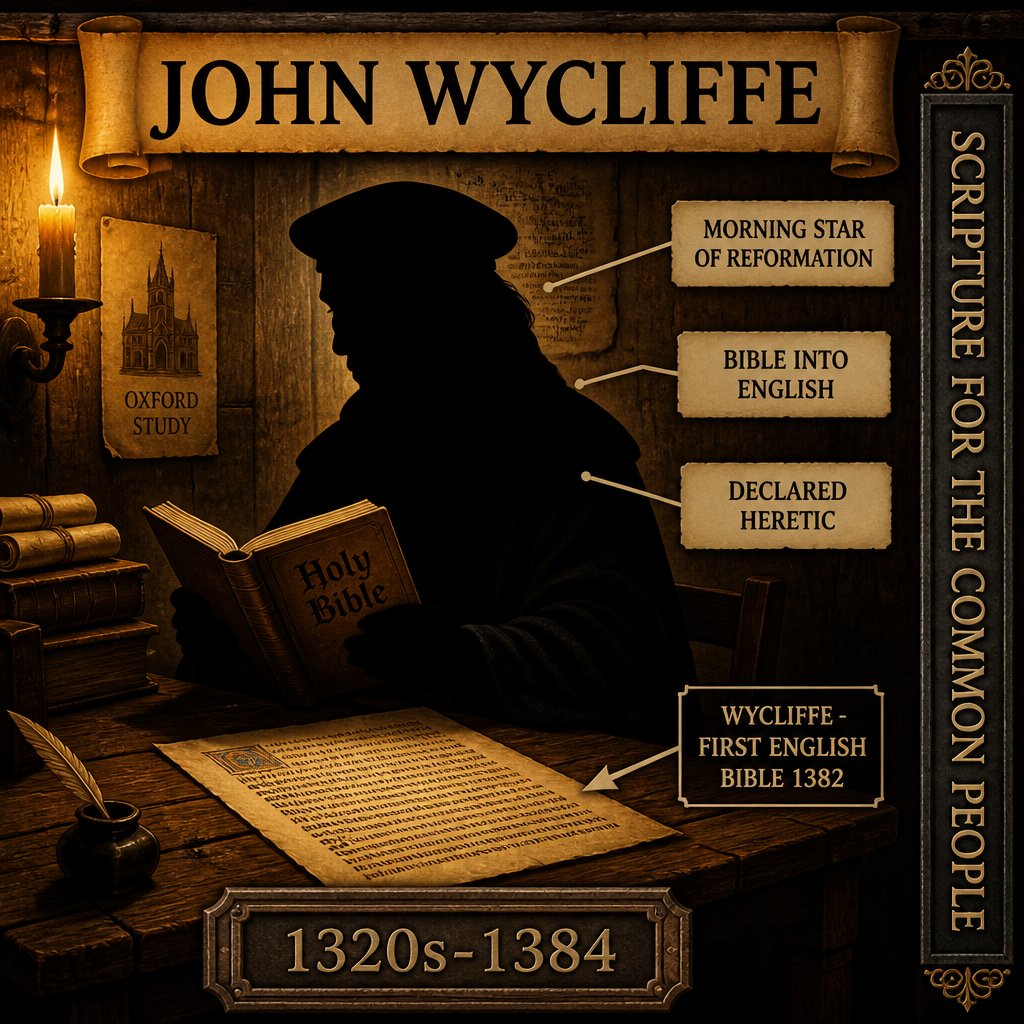
John Wycliffe was an Oxford professor and theologian who became known as the "Morning Star of the Reformation" because he challenged church corruption nearly 150 years before Martin Luther. Like the morning star appears before dawn, Wycliffe shone light before the Reformation's full sunrise.
Wycliffe supervised the translation of the entire Bible into English (completed around 1384). This was revolutionary - for the first time, English-speaking people could read Scripture in their own language. The work was likely done by Wycliffe and his associates, particularly Nicholas of Hereford for the Old Testament.
Remarkable fact: Over 250 handwritten manuscript copies of the Wycliffe Bible survive today - extraordinary for a book that was banned and its possessors persecuted!
Wycliffe's followers were called "Lollards" (meaning "mumblers" - a mocking term for their Bible reading). These brave believers continued spreading Scripture after Wycliffe's death, despite severe persecution. They carried handwritten portions of the English Bible throughout England, reading it to common people who had never heard Scripture in their own language.
Wycliffe died of natural causes in 1384, but the church's hatred followed him beyond the grave. The Council of Constance (1415) posthumously condemned him on 260 counts of heresy. Then, in 1428 - forty-four years after his death - church authorities ordered his bones dug up and burned, with his ashes cast into the River Swift.
1. Why do you think the church was so threatened by an English Bible that they burned Wycliffe's bones 44 years after his death?
2. Thomas Fuller said Wycliffe's ashes being scattered into rivers was like his doctrine spreading worldwide. How did this "curse" become a blessing?
3. The Lollards risked their lives to share Scripture. What would you risk to share Yahuah's Word?
Psalm 119:105 - "Thy word is a lamp unto my feet, and a light unto my path."
Practice saying aloud:
Personal Application: Wycliffe's motto was "Scripture is the highest authority." Make a list of situations where you need to let Scripture guide you rather than popular opinion:
YOUTH Reform Tyndale
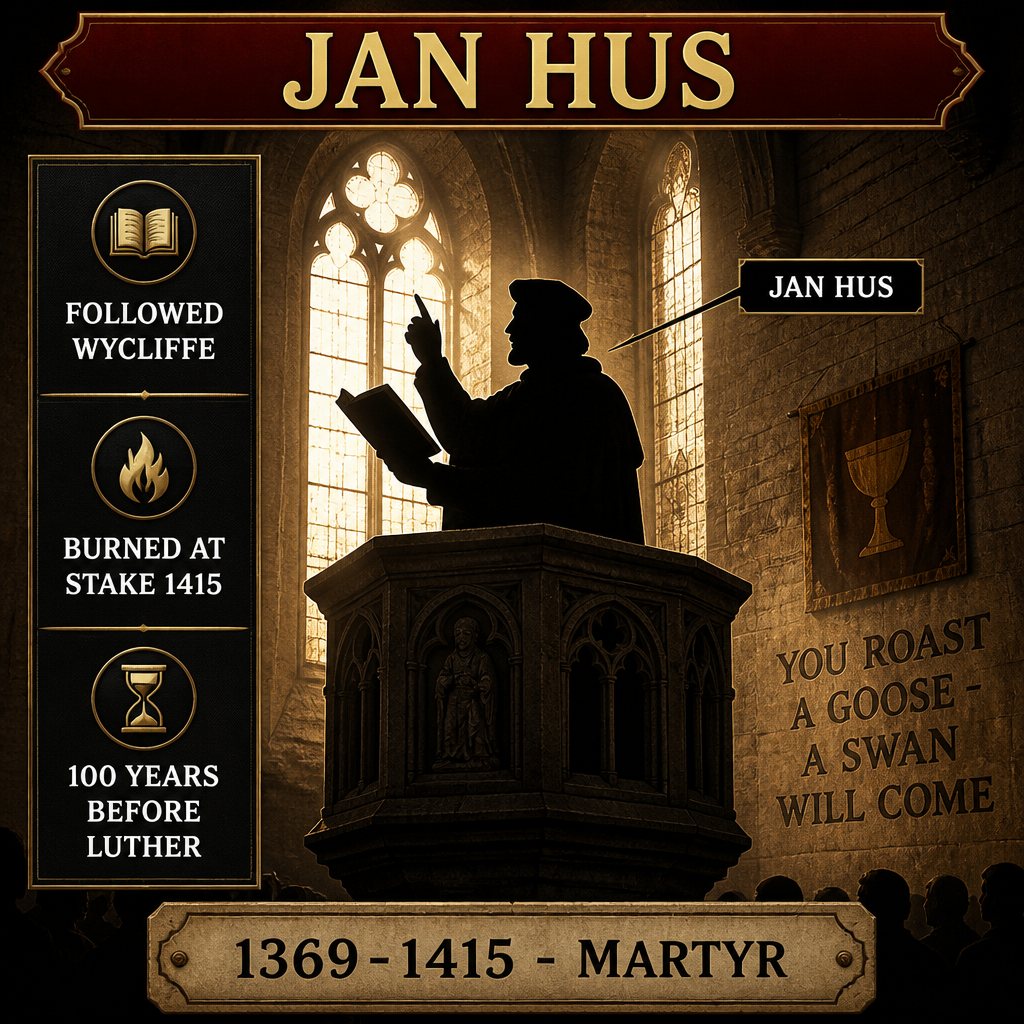
Jan Hus (pronounced "Yahn Hoose") was a priest and professor in Prague who was deeply influenced by Wycliffe's writings. His name "Hus" means "goose" in Czech - a detail that would become prophetically significant.
In 1411-1412, Hus vehemently denounced the sale of indulgences in Prague. He argued that Scripture, not the Pope, was the ultimate standard of truth. His major work, De Ecclesia (On the Church), borrowed approximately 23% directly from Wycliffe's writings.
In 1414, Emperor Sigismund issued a formal safe conduct letter guaranteeing Hus protection to travel to the Council of Constance to defend his teachings. Hus arrived on November 3, 1414. Within three weeks, he was arrested.
How could they arrest someone with an imperial safe conduct? The Council justified it by claiming safe conduct did not apply to heretics. Hus was held in a dungeon "next to a sewer" for 73 days, "chained day and night, poorly fed, and ill."
Condemned on thirty charges, Hus requested to be "convinced from Scripture" - but was refused. His accusers wanted submission, not debate. Before his execution, Hus knelt and "asked Yahuah with a soft voice to forgive all his enemies." Then he was burned at the stake, his ashes scattered in the Rhine River to prevent any relics.
Hus showed that standing for truth may cost everything - even your life. His followers, the Hussites, continued fighting for religious freedom in Bohemia for decades after his death. His influence on later reformers, especially Luther, was immense.
1. The emperor's safe conduct was broken because "it didn't apply to heretics." What does this tell you about how power was used?
2. Hus asked to be "convinced from Scripture" but was refused. Why do you think his accusers wouldn't debate Scripture?
3. Before dying, Hus prayed for his enemies to be forgiven. How does this reflect Yahusha's example on the cross (Luke 23:34)?
Revelation 2:10 - "Fear none of those things which thou shalt suffer... be thou faithful unto death, and I will give thee a crown of life."
Practice saying aloud:
Personal Application: Hus was willing to die rather than deny truth. What truths from Scripture would you not compromise, even under pressure?
YOUTH Reform Luther 95
Martin Luther became an Augustinian monk after a terrifying experience during a thunderstorm when he vowed to become a monk if spared. But monastic life did not bring him peace. He later wrote:
Luther's breakthrough came while studying Romans. He called it the "Tower Experience" (likely in the tower room of his monastery). He finally understood that Yahuah's righteousness was not about judging sinners but about justifying them through faith:
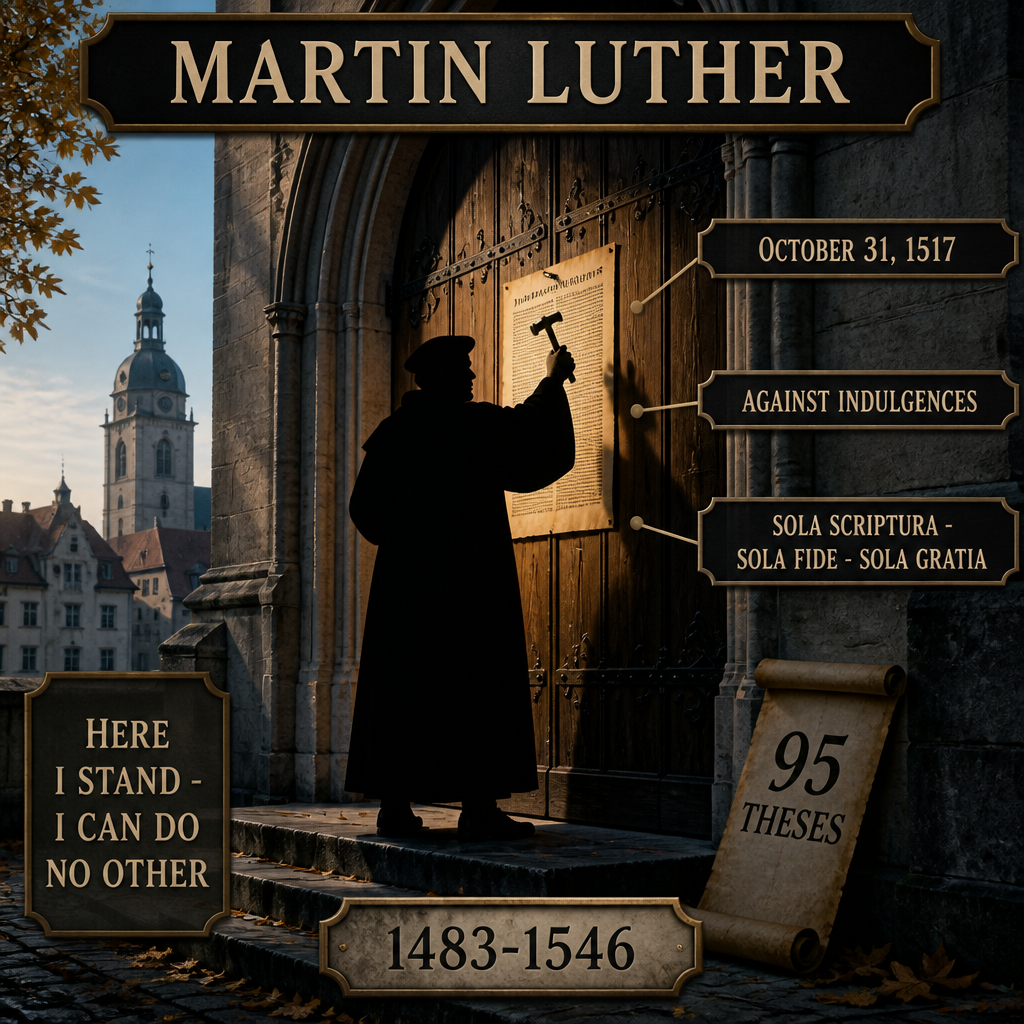
When Johann Tetzel began selling indulgences near Wittenberg with the slogan "As soon as a coin in the coffer rings, a soul from purgatory springs," Luther responded with 95 propositions for debate. His first thesis stated:
Thesis 62 declared: "The true treasure of the Church is the Most Holy Gospel of the glory and the grace of Yahuah."
Luther was summoned before Emperor Charles V at the Diet (assembly) of Worms to answer for his writings. The official transcript records his declaration:
While hiding at Wartburg Castle (protected by Frederick the Wise), Luther translated the New Testament into German in just 11 weeks. This gave German-speaking people Scripture in their own language - a revolutionary act that changed history.
1. Luther said his conscience was "captive to the Word of Yahuah." What does it mean to have your conscience captive to Scripture?
2. Luther discovered that righteousness comes through faith, not works. How does understanding this bring peace?
3. Does it matter that "Here I stand" might not be Luther's exact words? What DO we know he said, and is that enough?
Romans 1:17 - "For therein is the righteousness of Yahuah revealed from faith to faith: as it is written, The just shall live by faith."
Practice saying aloud:
| 1. "Repent" (Thesis 1) | |
| 2. "Tower Experience" | |
| 3. Diet of Worms | |
| 4. Wartburg Castle |
A. Where Luther translated the German New Testament
B. Entire Christian life should be repentance
C. Luther's discovery of justification by faith
D. Where Luther refused to recant
Personal Application: Luther discovered that trying to earn Yahuah's favor through works only brought despair, but faith in Yahusha brought freedom. Do you ever struggle with trying to "earn" Yahuah's love? How does the gospel free you?
YOUTH Reform Constantine Sunday
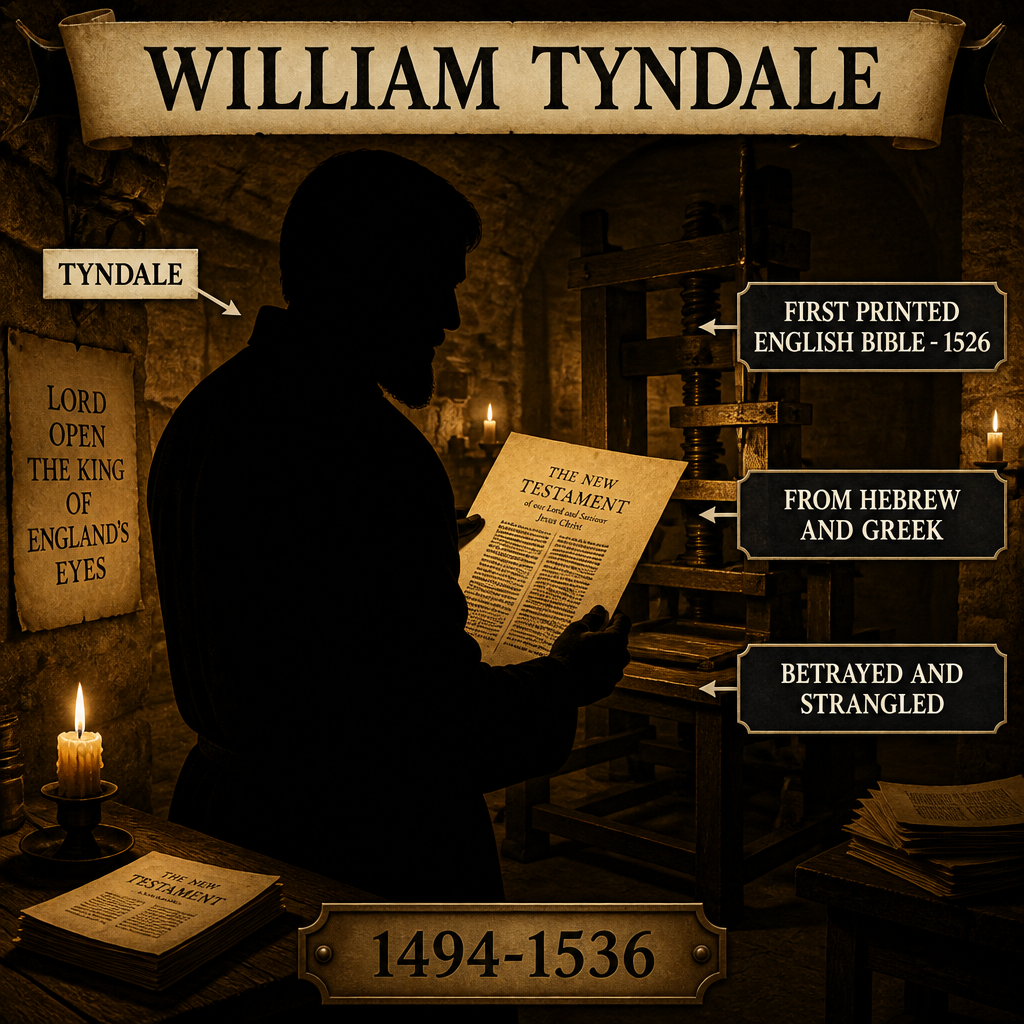
William Tyndale was an English scholar who devoted his life to one mission: translating Scripture into English so common people could read it. Unlike Wycliffe's translation (from Latin), Tyndale translated directly from the original Hebrew and Greek texts, using Erasmus's Greek New Testament.
Scholarly analysis confirms Tyndale's massive influence on the King James Bible: 84% of the KJV New Testament and 76% of the Old Testament derive from Tyndale's work (1998 study in Reformation journal).
Many familiar phrases originate with Tyndale:
He even coined words still used today: "Passover," "scapegoat," "atonement."
In 1525-26, Tyndale completed the first printed English New Testament. Unlike Wycliffe's hand-copied Bibles, Tyndale's could be mass-produced on the printing press, making Scripture available to thousands.
In Antwerp, Henry Phillips befriended Tyndale, then betrayed him. Foxe records that Phillips signaled waiting officers by "pointing down with his finger" and "jostled Tyndale forward into the officers, who bound him with ropes."
Tyndale was imprisoned at Vilvoorde Castle for about 500 days. On October 6, 1536, he was strangled and burned. His final words, recorded by Foxe:
Within two years of Tyndale's death, King Henry VIII ordered an English Bible (largely Tyndale's translation) to be placed in every church in England. The king's eyes were opened - just as Tyndale had prayed.
1. Tyndale was betrayed by someone who pretended to be his friend. How do you guard yourself against false friends while still being loving to others?
2. Tyndale's last prayer was answered within two years. What does this teach you about praying even when you won't see the answer?
3. When you read the King James Bible, you're reading 84% Tyndale. How does knowing this change your appreciation for Scripture?
Matthew 5:10 - "Blessed are they which are persecuted for righteousness' sake: for theirs is the kingdom of heaven."
Practice saying aloud:
Personal Application: Tyndale dedicated his life to getting Scripture into the hands of common people. What will you do to help others have access to Yahuah's Word?
YOUTH Reform Indulgences
John Calvin was trained as a lawyer in France before his "sudden conversion." In his Commentary on the Psalms (1557), he described how "Yahuah by a sudden conversion subdued and brought my mind to a teachable frame."
Calvin's masterwork, first published in 1536 (when he was only 26), became the most influential systematic theology of the Reformation. The final 1559 edition organized Protestant theology into a comprehensive framework.
Calvin's clear statements on the papacy:
Calvin, along with other reformers, emphasized these foundational principles:
| Latin | English | Meaning |
|---|---|---|
| Sola Scriptura | Scripture Alone | The Bible is the only infallible authority |
| Sola Fide | Faith Alone | We are justified by faith, not works |
| Sola Gratia | Grace Alone | Salvation is entirely by Yahuah's grace |
| Solus Christus | Christ Alone | Yahusha is the only mediator |
| Soli Deo Gloria | To Yahuah Alone Be the Glory | All glory belongs to Yahuah, not man |
Calvin established a model of church government in Geneva that influenced Presbyterian and Reformed churches worldwide. The Consistory (church governing body) met every Thursday to address sins and maintain discipline in the church.
The Servetus affair (1553) remains a dark chapter. Michael Servetus, who denied the Trinity, was condemned and burned at the stake in Geneva. Although Calvin requested the more merciful beheading (which was rejected by the Council), his involvement in the execution has been justly criticized. This reminds us that even great reformers were flawed human beings who sometimes failed to apply their own principles consistently.
1. Calvin experienced a "sudden conversion" where Yahuah subdued his mind. Have you experienced a moment when Yahuah changed your heart or understanding?
2. The Five Solas all emphasize "alone" - Scripture alone, faith alone, grace alone, etc. Why is "alone" so important to these doctrines?
3. The Servetus affair shows that even great reformers made serious mistakes. How should we view historical heroes who had both great strengths and significant failures?
Ephesians 2:8-9 - "For by grace are ye saved through faith; and that not of yourselves: it is the gift of Yahuah: Not of works, lest any man should boast."
Practice saying aloud (the Five Solas):
| 1. Sola Scriptura | |
| 2. Sola Fide | |
| 3. Sola Gratia | |
| 4. Solus Christus | |
| 5. Soli Deo Gloria |
A. Yahusha is the only mediator
B. The Bible is the only infallible authority
C. Salvation is by Yahuah's unmerited favor
D. All glory belongs to Yahuah
E. We are justified by believing, not earning
Personal Application: Which of the Five Solas speaks most to you right now? Why? How will you apply it this week?
YOUTH Reform Counter
John Knox's first sermon at St. Andrews in 1547 immediately "struck at the root of the popery, by boldly pronouncing the Pope to be the Antichrist." From his very first public message, Knox made his position unmistakably clear.
Knox is famous for his confrontations with Mary Queen of Scots, documented in his own History of the Reformation in Scotland. He described his calling:
When Mary declared "Ye are not the Kirk that I will nurse," Knox boldly responded:
Knox is credited with saying "One man with Yahuah is a majority." This captures his conviction that truth is not determined by numbers but by faithfulness to Yahuah's Word. He stood against kings, queens, and entire nations when necessary.
Knox's work established the Presbyterian Church of Scotland, which became the national church in 1560. His influence shaped Scottish culture, education, and government for centuries. The Scottish model of church government - with elders, sessions, and presbyteries - spread worldwide.
Knox was not afraid of anyone. Mary Queen of Scots reportedly said she feared Knox's prayers more than all the armies of Europe. His fiery preaching could move crowds to action - sometimes too much action. He remains controversial but undeniably effective in bringing the Reformation to Scotland.
1. Knox told Mary that "Your will, Madam, is no reason." What was he saying about truth - that it doesn't depend on royal authority?
2. "One man with Yahuah is a majority." Have you ever had to stand for truth alone? How did it feel?
3. Mary feared Knox's prayers more than armies. Why would prayers be more powerful than military force?
1 Kings 18:21 - "And Elijah came unto all the people, and said, How long halt ye between two opinions? If Yahuah be Elohim, follow him: but if Baal, then follow him."
Practice saying aloud:
Personal Application: Knox was willing to stand alone for truth. What truth from Scripture might you need to stand for, even if others disagree?
YOUTH Reform Geneva Bible
Peter Waldo (also called Valdes), a wealthy merchant in Lyon, France, experienced spiritual awakening around 1170-1173. He hired scholars to translate the Bible into the common language (Franco-Provencal), sold his possessions, and began street preaching.
The movement spread rapidly. In 1179, Pope Alexander III approved their vow of poverty but forbade unauthorized preaching. In 1184, Pope Lucius III issued the bull Ad abolendam condemning the "Poor of Lyon" to perpetual anathema.
On Easter Saturday, an army of approximately 15,000 soldiers turned on the Waldensian population after being quartered with families. Contemporary accounts document horrific atrocities - mothers with infants hurled from cliffs, mass killings, villages razed.
Death toll estimates range from 1,712 (one contemporary count) to 4,000-6,000 including subsequent deaths.
England's Lord Protector Oliver Cromwell responded strongly:
1. The Waldenses memorized large portions of Scripture. Why was this important when Bibles could be confiscated?
2. The Piedmont Massacre happened on Easter. Why do you think the attackers chose this timing?
3. Milton wrote "Even them who kept thy truth so pure of old, when all our fathers worshiped stocks and stones." What does this say about the Waldenses' faithfulness through history?
Revelation 12:17 - "And the dragon was wroth with the woman, and went to make war with the remnant of her seed, which keep the commandments of Yahuah, and have the testimony of Yahusha Messiah."
Practice saying aloud:
Personal Application: The Waldenses memorized Scripture so it couldn't be taken from them. How much Scripture do you have memorized? Set a goal for memorization:
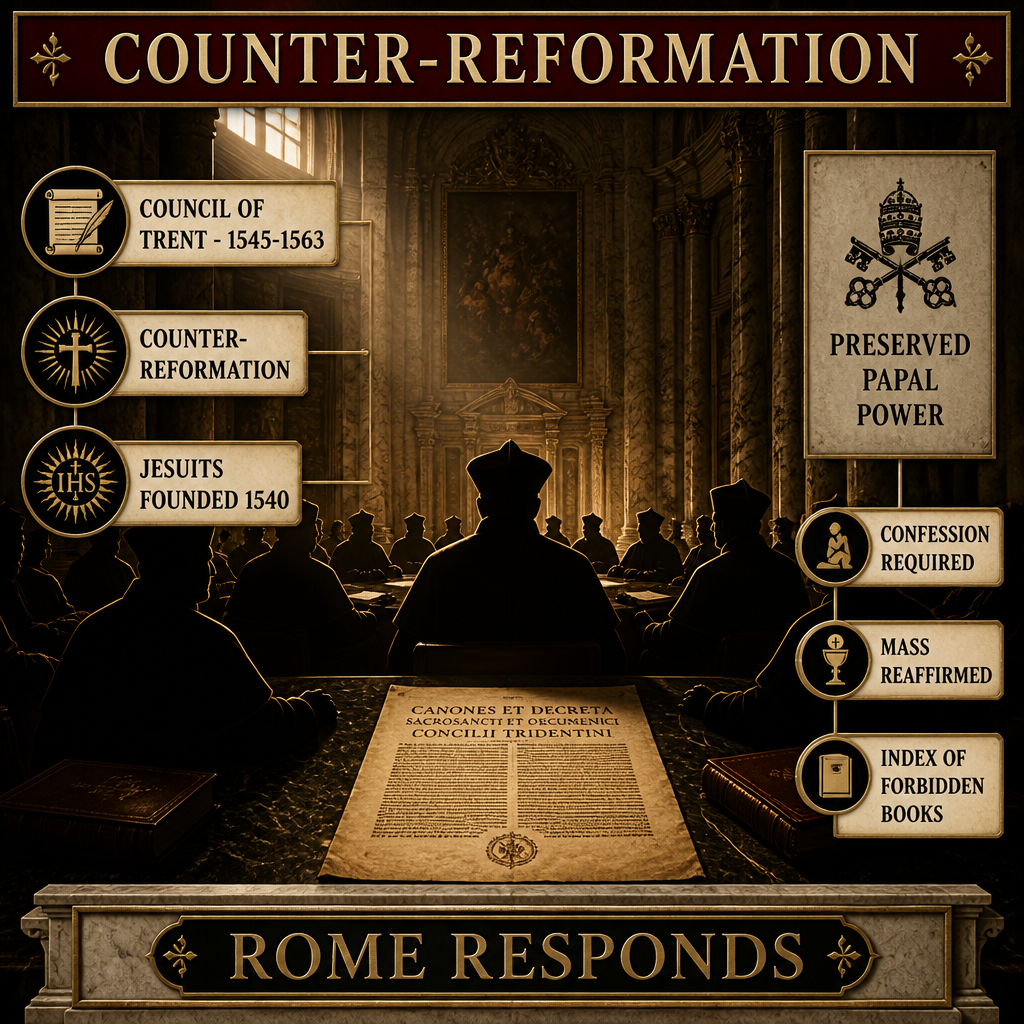
The Protestant Reformation shook the Roman Catholic Church to its foundation. The church responded with a "Counter-Reformation" designed to stop the Protestant movement and reclaim territory lost to Reformation teaching.
The Council held 25 sessions over 18 years, issuing 126 anathemas (curses/condemnations) against Protestant teachings.
Key declarations:
On Tradition equal to Scripture (Session 4, 1546):
Against Sola Fide (Canon 9):
The reformers had identified the papacy as the Antichrist based on Daniel and Revelation. The Jesuits developed two counter-interpretations to deflect this identification:
| Interpretation | Developed By | What It Teaches |
|---|---|---|
| Futurism | Francisco Ribera (1590) | The Antichrist will be a single individual in the distant future who will reign for a literal 3.5 years |
| Preterism | Luis de Alcazar (1614) | Everything in Revelation was already fulfilled in ancient Rome. Nero was the Antichrist |
Both interpretations remove the papacy from prophetic condemnation - one by pushing fulfillment into the future, the other by pushing it into the past.
Remarkably, these Jesuit interpretations eventually infiltrated Protestant churches:
LeRoy Edwin Froom documented: "In Ribera's commentary was laid the foundation for that great structure of Futurism... And then, wonder of wonders, in the nineteenth century this Jesuit scheme of interpretation came to be adopted by a growing number of Protestants."
Pope Paul IV's 1559 Index condemned nearly 550 authors and their complete works, including all writings of Protestant "heresiarchs" (Luther, Zwingli, Calvin). By its final edition, the Index contained over 4,000 titles. It was finally abolished in 1966.
1. The Council of Trent placed tradition "equal" to Scripture. Why is this a problem according to Sola Scriptura?
2. Both Futurism and Preterism remove the papacy from prophetic condemnation. Why would this have been important to the Catholic Church?
3. Why is it significant that many Protestant churches today have adopted interpretations originally developed by Jesuits to defend the papacy?
2 Thessalonians 2:3-4 - "Let no man deceive you by any means: for that day shall not come, except there come a falling away first, and that man of sin be revealed, the son of perdition; Who opposeth and exalteth himself above all that is called Yahuah, or that is worshipped..."
Practice saying aloud:
| 1. Futurism | |
| 2. Preterism | |
| 3. Historicism |
A. Prophecy was already fulfilled in the past (Nero was Antichrist)
B. Prophecy unfolds through history (Reformers' view - papacy is Antichrist)
C. Prophecy will be fulfilled in the distant future (future individual Antichrist)
Personal Application: The Counter-Reformation shows how truth can be gradually replaced with error over generations. How can you guard yourself against accepting teachings that contradict what the reformers understood from Scripture?
The Protestant Reformation fundamentally reshaped Christianity and Western civilization. Its legacy continues to shape how we understand faith, authority, and freedom.
The reformers' return to Scripture as ultimate authority remains their greatest legacy. Because of them, we believe:
Thanks to Wycliffe, Tyndale, Luther, and others, Scripture moved from Latin-only to every language on earth. Today the Bible is available in over 700 languages with complete translations, and portions exist in over 3,500 languages.
Luther taught that every believer has direct access to Yahuah through Yahusha - no human mediator required. This revolutionary idea meant:
The reformers recovered the biblical truth that salvation comes through faith in Yahusha's finished work, not through human effort or church rituals. As Paul wrote: "For by grace are ye saved through faith; and that not of yourselves: it is the gift of Yahuah: Not of works, lest any man should boast" (Ephesians 2:8-9).
Though not fully realized immediately, the Reformation planted seeds of religious freedom that eventually grew into constitutional protections. If conscience is captive to Yahuah's Word (as Luther said), then no earthly power has the right to coerce conscience.
All the major reformers - Luther, Calvin, Knox, Tyndale, and others - identified the papal system as the Antichrist described in Daniel and Revelation. This wasn't hostility but careful Bible study. The Smalcald Articles (1537), a Lutheran confessional document, declares:
The reformers made tremendous progress, but they also retained some errors and made new ones. The Reformation was not an endpoint but a beginning - a return to Scripture that continues today. Each generation must ask: "Does our faith and practice align with Scripture?"
1. The reformers gave their lives so you could read the Bible in your own language. How does this knowledge affect your approach to Scripture?
2. "Priesthood of all believers" means you have direct access to Yahuah. How should this truth change your prayer life?
3. The reformers said each generation must continue returning to Scripture. What areas of your faith might need reformation - alignment with Scripture?
John 8:31-32 - "Then said Yahusha to those Hebrews which believed on him, If ye continue in my word, then are ye my disciples indeed; And ye shall know the truth, and the truth shall make you free."
Practice saying aloud (the Five Solas):
| 1. John Wycliffe | |
| 2. Jan Hus | |
| 3. Martin Luther | |
| 4. William Tyndale | |
| 5. John Calvin | |
| 6. John Knox |
A. First printed English New Testament (84% of KJV NT)
B. 95 Theses, German Bible, justification by faith
C. First English Bible, "Morning Star of Reformation"
D. Burned at stake in Prague, inspired later reformers
E. Institutes of the Christian Religion, Geneva model
F. Scottish Presbyterian Church, confronted Mary Queen of Scots
Personal Declaration: Write your own commitment to the principles of the Reformation:
Final Prayer: Thank Yahuah for the reformers who sacrificed so you could know His Word. Ask Him to help you be faithful to Scripture in your generation.