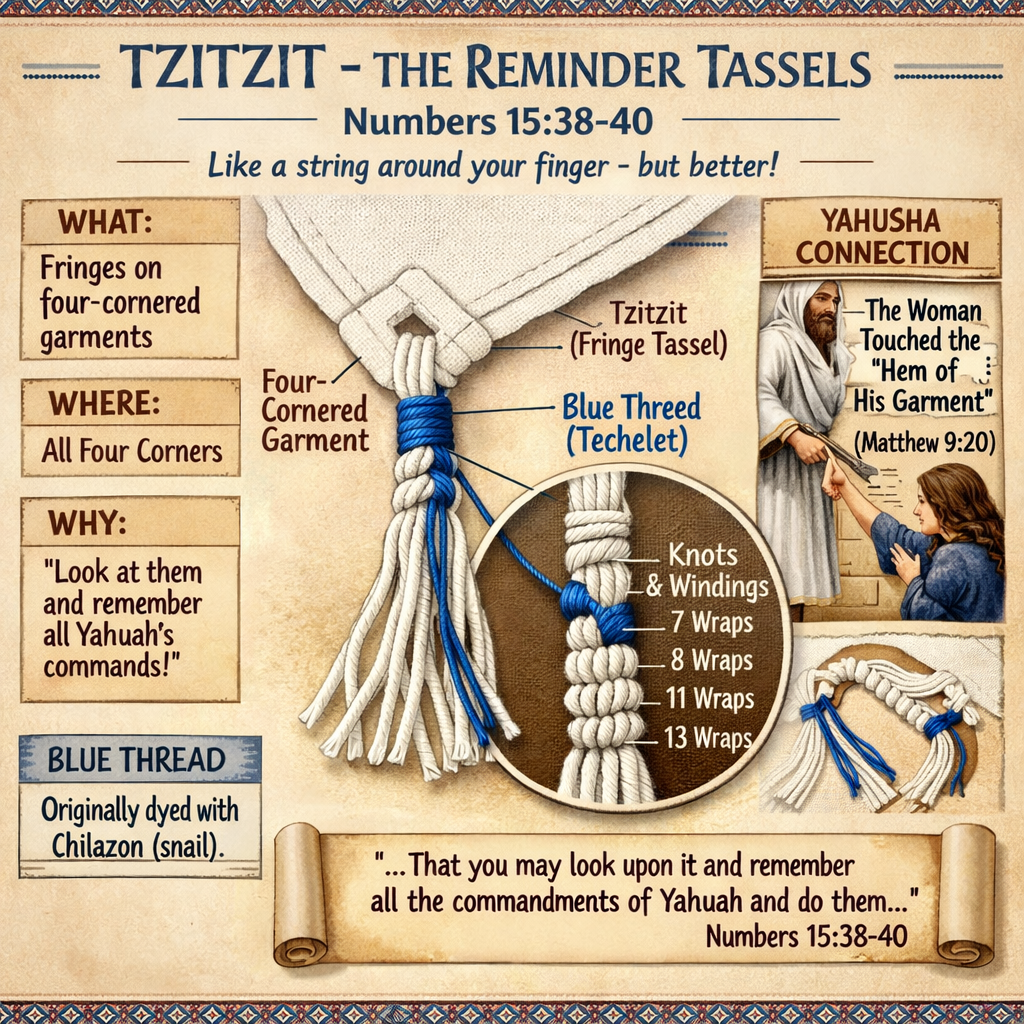
Numbers 15:39
"And you shall have the tassel, that you may look upon it and remember all the commandments of Yahuah and do them."
What Are Tzitzit?
Tzitzit (say: tsee-TSEET) are special tassels or fringes that Yahuah commanded His people to wear on the corners of their garments. They serve as visual reminders to keep all of His commandments.
In this study, you'll learn:
What Scripture says about tzitzit
The significance of the blue thread
How Yahusha wore and used tzitzit
How to tie and wear tzitzit today
Why this command still matters for believers
HOW TO USE THIS WORKBOOK
The 6Rs Learning Method
1. RECEIVE Read the teaching content carefully.
2. REFLECT Answer the questions thoughtfully.
3. RECALL Close the book and write from memory.
4. RECITE Teach the lesson to someone else.
5. REVIEW Use the tracker: Days 1, 3, 7, 21, 60.
6. RESPOND Apply what you've learned this week.
Sacred Names: Yahuah (the Father), Yahusha (the Messiah), Elohim (Mighty One)
LESSON 1: THE COMMAND IN SCRIPTURE
RECEIVE — Read and Learn
Numbers 15:38-40
"Speak to the children of Israel: Tell them to make tassels on the corners of their garments throughout their generations, and to put a blue thread in the tassels of the corners. And you shall have the tassel, that you may look upon it and remember all the commandments of Yahuah and do them, and that you may not follow the harlotry to which your own heart and your own eyes are inclined."
צִיצִת
Tzitzit — "Tassel, fringe" Strong's Hebrew #6734
Five Key Points from This Command:
WHO: "Children of Israel" — all covenant people
WHAT: Make tzitzit (tassels) on garment corners
WHEN: "Throughout their generations" — this is ongoing!
WHERE: On the four corners of garments
WHY: To REMEMBER and DO Yahuah's commandments
Deuteronomy 22:12
"You shall make yourself tassels on the four corners of the clothing with which you cover yourself."
What Does This Mean Today?
Since modern clothes don't have four corners, believers today often wear:
Tallit Gadol: A large prayer shawl worn during prayer
Tallit Katan: A small poncho-style garment worn under or over a shirt
Tzitzit attached to belt loops as a daily reminder
REFLECT — Answer Questions
Multiple Choice
1. The main purpose of tzitzit is to:
○ A) Look more religious than others
○ B) Remember and do Yahuah's commandments
○ C) Show ethnic identity
○ D) Protect from evil spirits
2. The command says to wear tzitzit:
○ A) Only during feasts
○ B) Only in Bible times
○ C) Throughout all generations
○ D) Only for priests
Fill in the Blanks:
1. Tzitzit are placed on the _____________ corners of garments.
2. Looking at tzitzit should help us _____________ all the commandments.
3. The Hebrew word for these tassels is _____________.
MEMORY VERSE — Numbers 15:39
"And you shall have the tassel, that you may look upon it and remember all the commandments of Yahuah and do them."
RECALL — Close Your Workbook
Write the five W's of the tzitzit command (Who, What, When, Where, Why):
RESPOND — This Week
LESSON 2: THE BLUE THREAD
RECEIVE — Read and Learn
תְּכֵלֶת
Tekhelet (teh-KHEH-let) — A specific shade of blue Strong's Hebrew #8504
Numbers 15:38 commands a blue thread in the tzitzit. This wasn't just any blue — it was a special color called tekhelet.
Where Else Was Tekhelet Used?
The Tabernacle curtains (Exodus 26:1)
The veil before the Holy of Holies (Exodus 26:31)
The High Priest's garments (Exodus 28:6, 31)
The cord holding the High Priest's crown (Exodus 28:37)
Did You Know?
The blue dye came from a sea creature called the chilazon — likely the Murex trunculus snail. It was extremely expensive — worth its weight in gold! The knowledge of how to make it was lost for about 1,300 years but was rediscovered in the 1990s.
What Does the Blue Represent?
Ancient Jewish sources explain: "Tekhelet resembles the sea, the sea resembles the sky, and the sky resembles the Throne of Glory."
The blue thread connects us visually from earth to heaven — a constant reminder that our citizenship is above!
REFLECT — Answer Questions
True or False
____ 1. Tekhelet was a cheap, common dye.
____ 2. The same blue was used in the High Priest's garments.
____ 3. The blue represents a connection from earth to heaven.
____ 4. We can't get authentic tekhelet anymore.
Fill in the Blanks:
1. The Hebrew word for the blue dye is _____________.
2. The blue came from a sea creature called the _____________.
3. Blue resembles the sea → sky → Throne of _____________.
RECALL — Close Your Workbook
List 3 things in the Tabernacle/Temple that used tekhelet:
RECITE — Teach Someone
Explain the symbolism: sea → sky → throne of glory
Person taught: Date:
LESSON 3: YAHUSHA WORE TZITZIT
RECEIVE — Read and Learn
Matthew 9:20-22
"And suddenly, a woman who had a flow of blood for twelve years came from behind and touched the hem of His garment. For she said to herself, 'If only I may touch His garment, I shall be made well.'"
The "Hem" = Tzitzit!
The Greek word translated "hem" is kraspedon — which specifically means "fringe, tassel." This is the same word used for tzitzit in the Greek translation of the Old Testament!
The woman touched Yahusha's tzitzit — not just the edge of His robe!
Malachi 4:2 (Prophecy)
"But to you who fear My name the Sun of Righteousness shall arise with healing in His wings."
The Hebrew word for "wings" here is kanaf — the same word used for the "corners" of the garment where tzitzit hang!
Prophecy Fulfilled!
Malachi prophesied the Messiah would have "healing in His kanaf (corners/wings)" — and Yahusha literally fulfilled this when people were healed by touching His tzitzit!
This proves that Yahusha, as a Torah-observant man, wore tzitzit. He kept every commandment, including Numbers 15:38. If the Son of Yahuah wore tzitzit, shouldn't His followers?
REFLECT — Answer Questions
Multiple Choice
1. What did the woman with the blood flow actually touch?
○ A) Yahusha's sleeve
○ B) The bottom edge of His robe
○ C) His tzitzit (tassels)
○ D) His belt
2. Malachi 4:2 prophesied:
○ A) The Messiah would fly
○ B) Healing in the Messiah's "wings/corners"
○ C) The sun would heal people
○ D) Birds would bring healing
Fill in the Blanks:
1. The Greek word "kraspedon" means _____________ or tassel.
2. The Hebrew word "kanaf" means both wings and _____________ of a garment.
3. The healing through tzitzit _____________ Malachi's prophecy.
RECALL — Close Your Workbook
Explain the connection between Malachi 4:2 and Matthew 9:20-22:
RESPOND — This Week
LESSON 4: HOW TO TIE AND WEAR TZITZIT
RECEIVE — Read and Learn
The Structure of Tzitzit
Each tzitzit is made of 8 threads (4 threads doubled over through a hole in the corner). One thread (the shamash) is longer and wraps around the others.
Element
Number
Significance
Wraps: 7 + 8
15
First two letters of Yahuah's name (YH)
Wraps: 11
11
Last two letters of Yahuah's name (VH)
Wraps: 13
13
"Echad" (ONE) — Yahuah is One!
Double Knots
5
Five books of Torah
Cool Math!
The Hebrew letters of צִיצִת (tzitzit) add up to 600. Add 8 threads + 5 knots = 613 — the traditional count of Torah commandments!
When and How to Wear
Numbers 15:39 says "that you may look upon it" — this implies wearing them when you can see them (daytime).
Option
Description
Tallit Gadol
Large prayer shawl worn during prayer
Tallit Katan (tucked)
Under shirt, tzitzit tucked in (private)
Tallit Katan (out)
Under shirt, tzitzit hanging out (visible)
Over clothing
Worn as a visible vest
Getting Started
You can buy pre-tied tzitzit or learn to tie your own
White wool or cotton thread is traditional
Add tekhelet (blue) if you can get it
Watch tutorial videos online to learn the knots
REFLECT — Answer Questions
Fill in the Blanks:
1. Each tzitzit has _____________ threads (4 doubled).
2. The longer wrapping thread is called the _____________.
3. The gematria (number value) of "tzitzit" + threads + knots = _____________.
4. A tallit katan is a _____________ four-cornered garment.
True or False
____ 1. All Jewish communities use exactly the same wrapping pattern.
____ 2. The wraps 7+8+11+13 spell out "Yahuah Echad."
____ 3. There is only one way to wear tzitzit.
RECALL — Close Your Workbook
List the four wearing options from the lesson:
RESPOND — This Week
LESSON 5: HEART CHECK — MOTIVES MATTER
RECEIVE — Read and Learn
Matthew 23:5
"But all their works they do to be seen by men. They make their phylacteries broad and enlarge the borders of their garments."
What Was Yahusha Criticizing?
Yahusha did NOT condemn wearing tzitzit — He wore them Himself! He criticized the motive:
"To be seen by men" — showing off
"Enlarge the borders" — making them extra big for attention
Pride and hypocrisy, not genuine obedience
RIGHT Motive
WRONG Motive
Remember Yahuah's commands
Impress others
Personal obedience
Public recognition
Humble reminder
Badge of superiority
Looking to heaven
Looking for applause
Who Can Wear Tzitzit?
The command was to "children of Israel." Through faith in Yahusha, Gentile believers are grafted into Israel (Romans 11) and share in the covenants.
Exodus 12:49
"One Torah shall be for the native-born and for the stranger who dwells among you."
REFLECT — Answer Questions
Multiple Choice
1. Yahusha's criticism in Matthew 23:5 was about:
○ A) Wearing tzitzit at all
○ B) Pride and showing off
○ C) Using the wrong color thread
○ D) Wearing them on Sabbath
2. Believers grafted into Israel:
○ A) Have no connection to Torah
○ B) Share in Israel's covenants
○ C) Must become ethnically Jewish
○ D) Cannot wear tzitzit
Fill in the Blanks:
1. The Pharisees did their works to be _____________ by men.
2. Yahusha criticized their _____________, not the tzitzit themselves.
3. Romans 11 teaches that Gentile believers are _____________ into Israel.
RECALL — Close Your Workbook
List 3 right motives and 3 wrong motives for wearing tzitzit:
RESPOND — Heart Check
LESSON 6: LIVING THE REMINDER DAILY
RECEIVE — Read and Learn
Numbers 15:39
"And you shall have the tassel, that you may look upon it and remember all the commandments of Yahuah and do them."
Three Actions in One Command:
LOOK — Intentionally glance at your tzitzit throughout the day
REMEMBER — Let them trigger remembrance of Yahuah's instructions
DO — Put the commands into action
Tzitzit are not magic — they're a trigger for obedience!
Practical Daily Integration
Morning: Put on tzitzit with prayer, setting intention for the day
Throughout day: When you notice your tzitzit, pause and remember Yahuah
Temptation: When tempted, look at tzitzit — "Would this honor Yahuah?"
Conversation: Use as opportunity to share faith when asked
Evening: Reflect: Did I remember and obey today?
Common Questions
"Isn't that just for Jews?"
Answer: Believers grafted into Israel through Messiah share in the covenants. "One Torah for native and stranger" (Exodus 12:49).
"We're not under the Law!"
Answer: "Under the law" means under its condemnation for sin — not free from obedience. We obey BECAUSE we're saved, not to GET saved.
"I don't need physical reminders."
Answer: Yahuah knows us better than we know ourselves. He commanded reminders because we NEED them. Wedding rings, communion, and baptism are all physical symbols too!
The Ripple Effect
Your siblings/children see obedience modeled
Other believers may be encouraged to study
Unbelievers may ask questions (witnessing opportunity)
You are reminded constantly of your identity
REFLECT — Final Questions
Fill in the Blanks:
1. The three actions in Numbers 15:39 are look, remember, and _____________.
2. Tzitzit are a _____________ for obedience, not magic.
3. We obey _____________ we're saved, not to get saved.
4. Wearing tzitzit can be a _____________ opportunity when asked about them.
RECALL — Final Summary
Write a summary of what you've learned: What are tzitzit, why wear them, and how?
RECITE — Final Teach-Back
Teach someone the full lesson: the command, symbolism, Yahusha's connection, and application.
Person taught: Date:
MY COMMITMENT
My commitment regarding tzitzit:
Signature: _________________ Date: _________
SPACED REVIEW TRACKER
Mark completion dates for each review:
Lesson
Done
Day 1
Day 3
Day 7
Day 21
Day 60
1. The Command
___
2. The Blue Thread
___
3. Yahusha Wore Tzitzit
___
4. How to Tie & Wear
___
5. Motives Matter
___
6. Living the Reminder
___
ANSWER KEY
Lesson 1
MC: 1-B, 2-C
Fill-ins: 1) four, 2) remember, 3) tzitzit
Lesson 2
T/F: 1-False, 2-True, 3-True, 4-False
Fill-ins: 1) tekhelet, 2) chilazon, 3) Glory
Lesson 3
MC: 1-C, 2-B
Fill-ins: 1) fringe, 2) corners, 3) fulfilled
Lesson 4
Fill-ins: 1) 8/eight, 2) shamash, 3) 613, 4) small