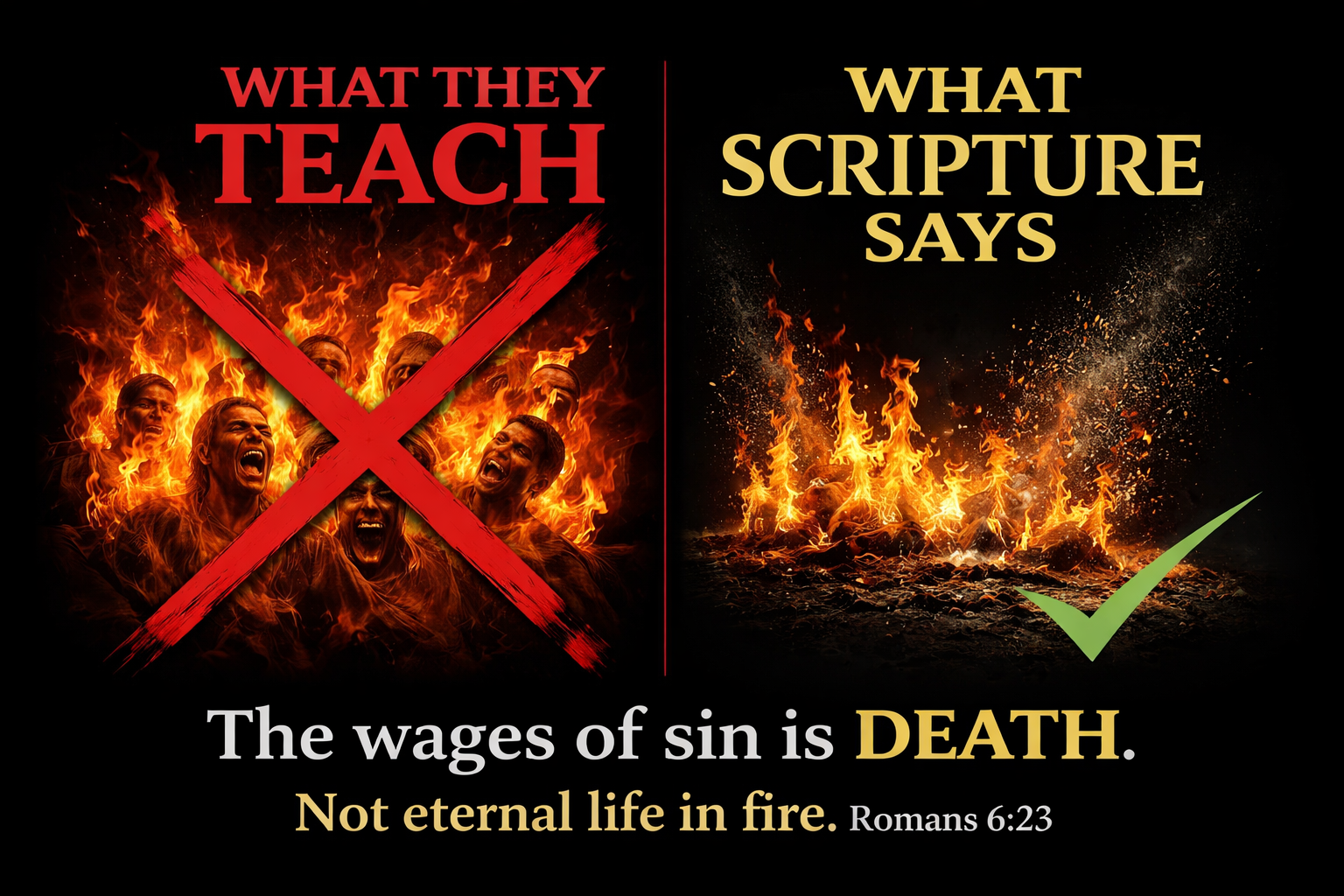
The wages of sin is death. Not eternal life in fire. Death.
Before we can understand the fate of the wicked, we must understand what death IS according to Scripture. The dead do not go to heaven or hell immediately. They are unconscious. They know nothing. They return to dust.
"For the living know that they shall die: but the dead know not any thing, neither have they any more a reward; for the memory of them is forgotten." Ecclesiastes 9:5
"His breath goeth forth, he returneth to his earth; in that very day his thoughts perish." Psalm 146:4
The dead have no thoughts. No consciousness. No experience. This is the consistent testimony of the Hebrew Scriptures. Death is a sleep, awaiting the resurrection. Yahusha Himself called death "sleep" (John 11:11-14). If the dead are already in heaven or hell, why would there need to be a resurrection and a judgment?
Scripture uses the language of destruction -- not preservation in torment -- when describing the fate of the wicked. This is not ambiguous. The vocabulary is deliberate and consistent across dozens of passages.
"And fear not them which kill the body, but are not able to kill the soul: but rather fear him which is able to destroy both soul and body in hell." Matthew 10:28
"For the wages of sin is death; but the gift of Elohim is eternal life through Yahusha the Messiah." Romans 6:23
"For Elohim so loved the world, that he gave his only begotten Son, that whosoever believeth in him should not perish, but have everlasting life." John 3:16
"Who shall be punished with everlasting destruction from the presence of the Master, and from the glory of his power." 2 Thessalonians 1:9
"For, behold, the day cometh, that shall burn as an oven; and all the proud, yea, and all that do wickedly, shall be stubble: and the day that cometh shall burn them up, saith Yahuah of hosts, that it shall leave them neither root nor branch... And ye shall tread down the wicked; for they shall be ashes under the soles of your feet." Malachi 4:1, 3
"But the wicked shall perish, and the enemies of Yahuah shall be as the fat of lambs: they shall consume; into smoke shall they consume away." Psalm 37:20
"And they shall be as though they had not been." Obadiah 1:16
Destroy. Death. Perish. Burn up. Ashes. Neither root nor branch. Consume away. As though they had not been. This is not the language of eternal conscious torment. This is the language of total, irreversible destruction.
"Who only hath immortality, dwelling in the light which no man can approach unto; whom no man hath seen, nor can see: to whom be honour and power everlasting. Amen." 1 Timothy 6:16
This single verse dismantles the entire doctrine of eternal torment. If ONLY Yahuah has immortality, then humans do NOT inherently possess it. The soul is not naturally immortal. Eternal life is a GIFT given to the righteous (Romans 6:23), not a default state of all humans.
The doctrine of the "immortal soul" did not come from Scripture. It came from Greek philosophy -- specifically from Plato. The Platonic concept of the immortal soul was absorbed into Christianity through the same Hellenization process that introduced Sunday worship, Easter, and Christmas. It is pagan philosophy dressed in biblical language.
The phrase "eternal fire" does not mean fire that burns forever. It means fire whose results are eternal -- permanent, irreversible destruction. Scripture itself proves this.
"Even as Sodom and Gomorrha, and the cities about them in like manner, giving themselves over to fornication, and going after strange flesh, are set forth for an example, suffering the vengeance of eternal fire." Jude 1:7
Sodom and Gomorrah suffered "eternal fire." Are they still burning today? No. The fire is long gone. The RESULTS are eternal -- those cities were permanently destroyed. The fire accomplished its purpose and went out. "Eternal" modifies the consequence, not the duration of the burning.
This is consistent with how "eternal" is used throughout Scripture. "Eternal judgment" (Hebrews 6:2) does not mean judging is happening forever. It means the judgment, once rendered, is permanent. "Eternal redemption" (Hebrews 9:12) does not mean the act of redeeming goes on forever. It means the redemption, once accomplished, is permanent.
The same grammar applies to "eternal fire" and "eternal punishment." The punishment is death (Romans 6:23). The death is eternal -- permanent, irreversible. Not an eternal process of dying.
"And they shall go forth, and look upon the carcases of the men that have transgressed against me: for their worm shall not die, neither shall their fire be quenched; and they shall be an abhorring unto all flesh." Isaiah 66:24
This is one of the verses most commonly cited in favor of eternal torment. But read it carefully. The Hebrew word is "pegar" -- meaning dead bodies, corpses, carcasses. These are not living, conscious beings writhing in agony. They are dead bodies being consumed.
You cannot torture a corpse. The righteous go out and LOOK at the dead bodies. The worm does not die and the fire is not quenched -- meaning nothing stops the process of consumption until it is complete. An "unquenchable fire" is one that cannot be put out, not one that burns forever. Jeremiah 17:27 says Jerusalem would burn with unquenchable fire -- it burned and went out. The city is not still on fire.
Yahusha quotes this verse in Mark 9:48. He is referencing Gehenna -- the Valley of Hinnom outside Jerusalem, a literal garbage dump where fires burned continuously and worms consumed refuse. It was an image of total destruction, not of eternal conscious existence in fire.
"And the smoke of their torment ascendeth up for ever and ever: and they have no rest day nor night, who worship the beast and his image, and whosoever receiveth the mark of his name." Revelation 14:11
This verse is often presented as the definitive proof of eternal torment. But examine the context carefully. This passage describes the present condition of beast worshippers -- those who have received the mark. They have "no rest day nor night."
What is the mark of the beast? It is the counterfeit of the Sabbath -- Sunday worship and allegiance to Rome's system (see our teaching on the Mark of the Beast). Those who keep Sunday instead of the Sabbath literally have "no rest" -- they do not keep Yahuah's rest day. They have no Sabbath. No rest. Day or night.
The "smoke ascending forever" echoes Isaiah 34:10, which describes the destruction of Edom: "the smoke thereof shall go up for ever; from generation to generation it shall lie waste." Edom is not still smoking. The language indicates completeness and permanence of judgment, not ongoing burning.
This is a description of the current state of Sabbath-less existence under the beast system -- a spiritual torment of being in the wrong system without the rest that Yahuah provides.
"And death and the grave were cast into the lake of fire. This is the second death. And whosoever was not found written in the book of life was cast into the lake of fire." Revelation 20:14-15
Notice the sequence. Death itself is thrown into the lake of fire BEFORE the wicked. Death is destroyed. The lake of fire is explicitly identified as "the second death" -- not "the second life in torment." Death. The second one. Final. Permanent.
There is a tension here that should be acknowledged honestly. Revelation 20:10 says the beast and the false prophet "shall be tormented day and night for ever and ever." This language is strong, and we should not minimize it. However, this verse specifically references the beast and the false prophet (systems/institutions), not individual human souls. Verse 14 then defines the lake of fire as "the second death" for human beings.
The second death is cessation of existence -- permanent, irreversible destruction. The tension with Revelation 20:10 is acknowledged, but the overwhelming weight of Scripture points to destruction, not preservation in torment.
The doctrine of eternal torment paints Yahuah as a being who would keep billions of people alive forever for the sole purpose of torturing them. This is the character of the adversary, not the character of the Creator. Yahuah is just. Justice is proportional. The punishment fits the crime. Finite sin does not warrant infinite torture. The wages of sin is death -- and death is enough.